
History of Union
Union’s history is easiest to begin at the courthouse, but it does not stay there. The streets around it connect county government to shops, homes, churches and the surrounding farm country. Together, they tell the story of a town that grew because people needed a place to conduct business—and made a community around those journeys.

How a county seat became a town
James Alexander settled here in 1774 and later contributed land for the town and Green Hill Cemetery. When Monroe County was formed in 1799, selecting a county seat gave the settlement a lasting purpose. A place for courts and records would draw people from beyond the immediate neighborhood.
Two dates appear in accounts of Union’s beginnings because they refer to different steps. David E. Johnston’s history records the county court selecting the site on Alexander’s land in 1799. Virginia’s legislature formally established Union on January 6, 1800. The county-seat decision came first; the legal establishment of the town followed.
The early trustees had an unusually specific idea of what the new town should look like. As architectural historian S. Allen Chambers Jr. explains, lot purchasers were directed to build two-story log houses with defined dimensions and construction requirements. The stipulation suggests an ambition for an orderly, substantial place, even when the settlement was small.
By 1808, a description cited in Chambers’s account recorded a courthouse, jail and about a dozen dwellings. Later nineteenth-century visitors described a larger village with shops, churches and a school. These accounts give the town’s growth a human scale: a community assembling its everyday institutions around the work of a county seat.
Reading the town through its buildings
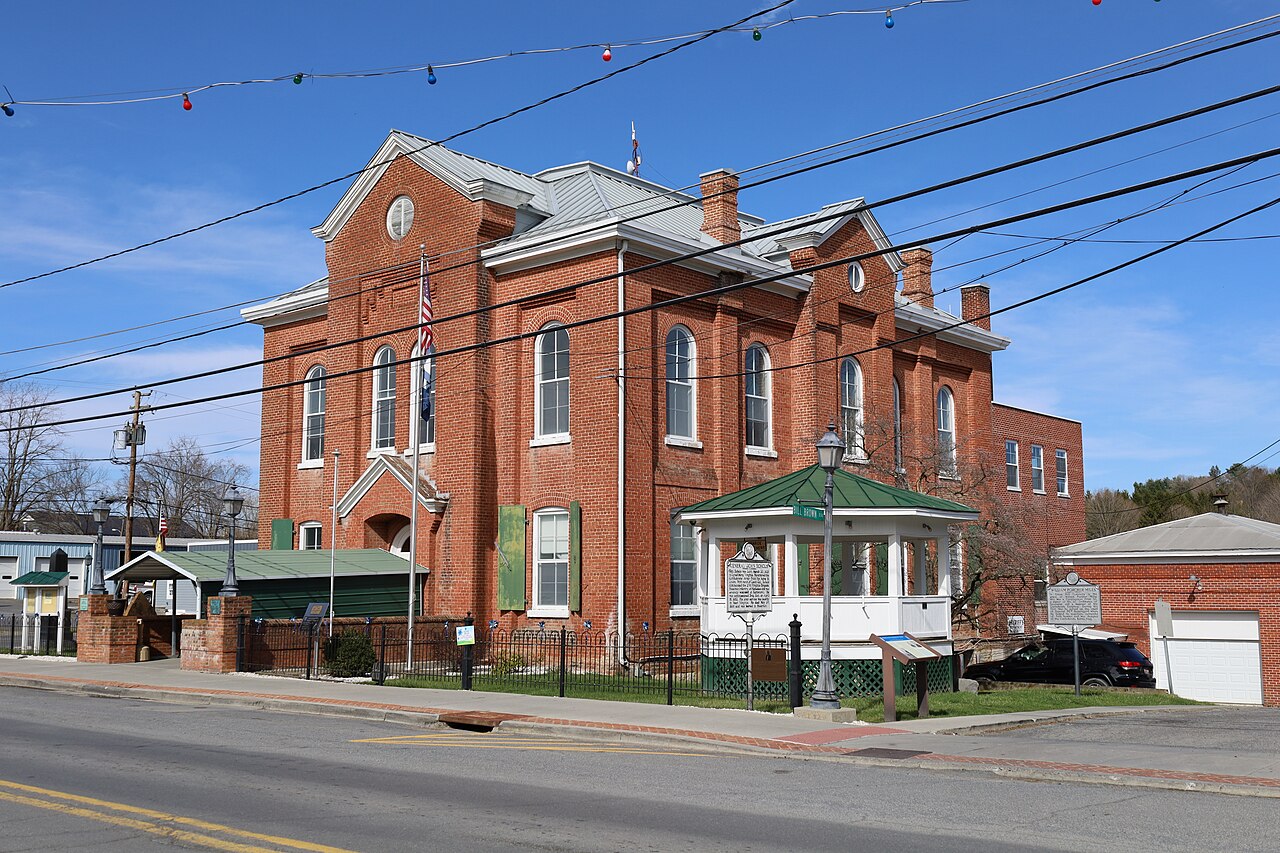
The first courthouse was a log building. A brick replacement followed in 1820, and the present courthouse was built in 1881. Those changes span much of the town’s early development. Standing near the current building, it is worth remembering that the same public purpose outlasted more than one structure.
The Union Historic District was listed on the National Register of Historic Places on December 6, 1990. Its boundaries take in portions of Main, Dunlap, Pump and Elmwood streets and associated open land. Greek Revival, Queen Anne and Bungalow/Craftsman buildings reflect different periods of growth. The variety is part of the story: this is a town that changed over generations, rather than a streetscape created at a single moment.
A walk becomes more interesting when you look for relationships. How close are houses to the places where people worked? Where do public buildings meet residential streets? Which buildings make a statement, and which served ordinary daily needs? You do not need to identify every architectural style to begin reading those connections.
The people behind the landmarks
Union’s name predates the Civil War. The West Virginia Encyclopedia connects it with militia gathering for drills during frontier conflict, rather than the later political meaning a visitor might assume. The same account notes that Union and the surrounding area generally supported the Confederacy. That history deserves context, including the lives of people whose experiences are not represented by a single monument.
One person whose story reaches well beyond the town is Matthew Wesley Clair Sr., born in Union in 1865. In 1920 he became one of the first African Americans elected bishop in the predominantly White Methodist Episcopal Church. His career included service in Liberia and later work in the United States. His life belongs in an account of Union alongside the better-known houses and government buildings.
The National Register recognizes Black history as one of the district’s areas of significance. Following that thread means asking who lived here, who could participate in public life, and whose work and institutions shaped the town. A richer history keeps those questions open and uses records to answer them, rather than allowing architecture alone to stand in for the whole community.
For a story that begins before the town’s charter, explore Old Rehoboth Church and the circuit riders. To see how water and work shaped another Monroe County community, continue to Cook’s Old Mill. Our history-day itinerary brings these interests into a visit with room to pause along the way.
Sources and further reading
West Virginia Encyclopedia: Union; S. Allen Chambers Jr., Union, SAH Archipedia; David E. Johnston, A History of Middle New River Settlements, page 135; Union Historic District National Register record, 90001844; Debra K. Sullivan, Matthew Wesley Clair Sr., West Virginia Encyclopedia. Reviewed October 28, 2026. Interpretive questions and visit suggestions are editorial guidance.